
Why Replacing Equipment Alone Often Does Not Solve Industrial Marking Problems
Technical Articles
Why Replacing Equipment Alone Often Does Not Solve Industrial Marking Problems
Industrial marking upgrades should redesign data flow, trigger logic, verification, abnormal handling and traceability rather than only replacing a laser, printer or labeler.
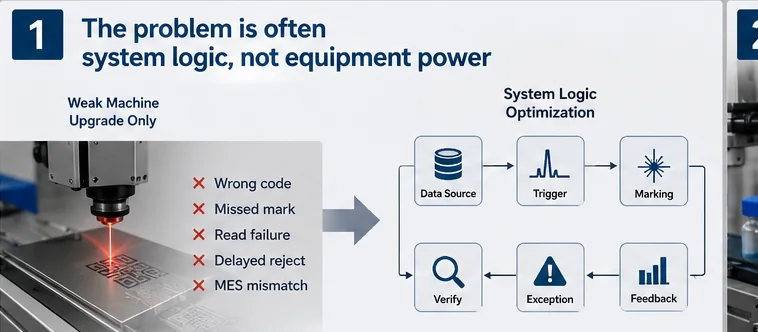
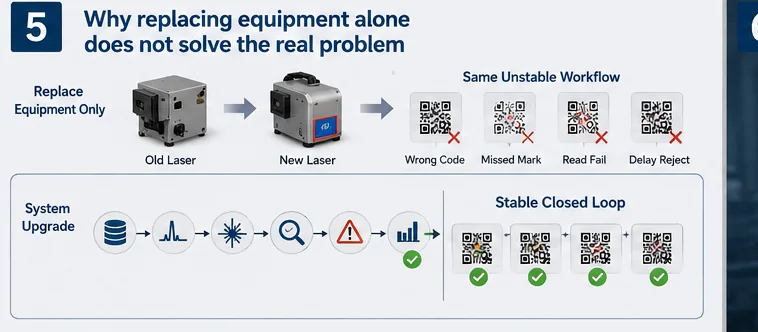
Many industrial marking projects start with a simple upgrade target: faster equipment, clearer marks or easier maintenance. The team replaces a laser marker, printer or labeling machine. Yet the line may still suffer from wrong codes, missed marks, read failures, delayed rejection or MES data mismatch.
The problem is often system logic, not equipment power
Industrial marking contains at least six linked steps: data source, action trigger, marking execution, result verification, abnormal handling and result feedback. Improving one machine can only improve one local action.
If MES sends a new work order but the equipment still holds the previous content, or if a sensor trigger is delayed, the problem is not laser power. It is data and control logic.
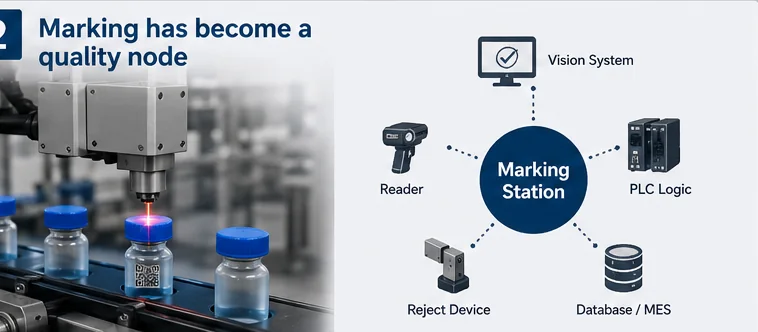
Marking has become a quality node
In regulated or traceability-driven production, marking is no longer just printing text. It confirms product identity, batch status, packaging level and inspection result.
A marking station should therefore connect with readers, vision systems, PLC logic, rejection mechanisms and databases.
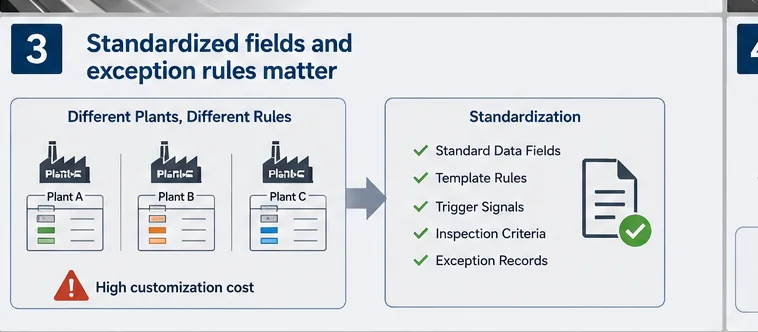
Standardized fields and exception rules matter
Different plants often use different fields, interfaces and abnormal-handling rules. Each new line then requires repeated customization, even when the equipment is similar.
A system upgrade should define standard data fields, template rules, trigger signals, inspection criteria and exception records.
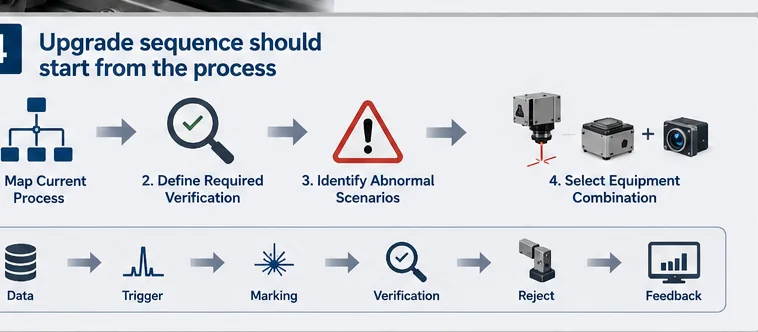
Upgrade sequence should start from the process
The better sequence is to map the current data flow, define required verification, identify abnormal scenarios, then select the equipment combination.
This prevents the factory from buying a stronger machine while keeping the same unstable workflow.
Practical takeaway
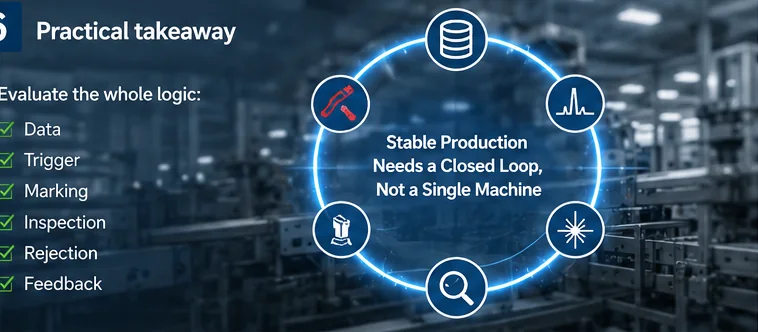
When marking problems repeat after equipment replacement, the factory should evaluate the whole logic: data, trigger, marking, inspection, rejection and feedback. Stable production comes from a closed loop, not from a single machine.
Need to evaluate a real production scenario?
Lugsicher can help review materials, marking targets, line speed, vision inspection and data feedback requirements before equipment selection.