
Why Vision Inspection Projects Should Define Standards Before Tuning Parameters
Technical Articles
Why Vision Inspection Projects Should Define Standards Before Tuning Parameters
A practical engineering view of why industrial vision inspection projects often fail at the standard-definition stage rather than at the camera or algorithm stage.
In many industrial vision inspection projects, teams first discuss camera resolution, lighting, algorithms and recognition speed. These factors matter, but they do not solve the most common implementation problem: the system has no stable business boundary unless the inspection standard is defined first.
Standard definition comes before parameter optimization
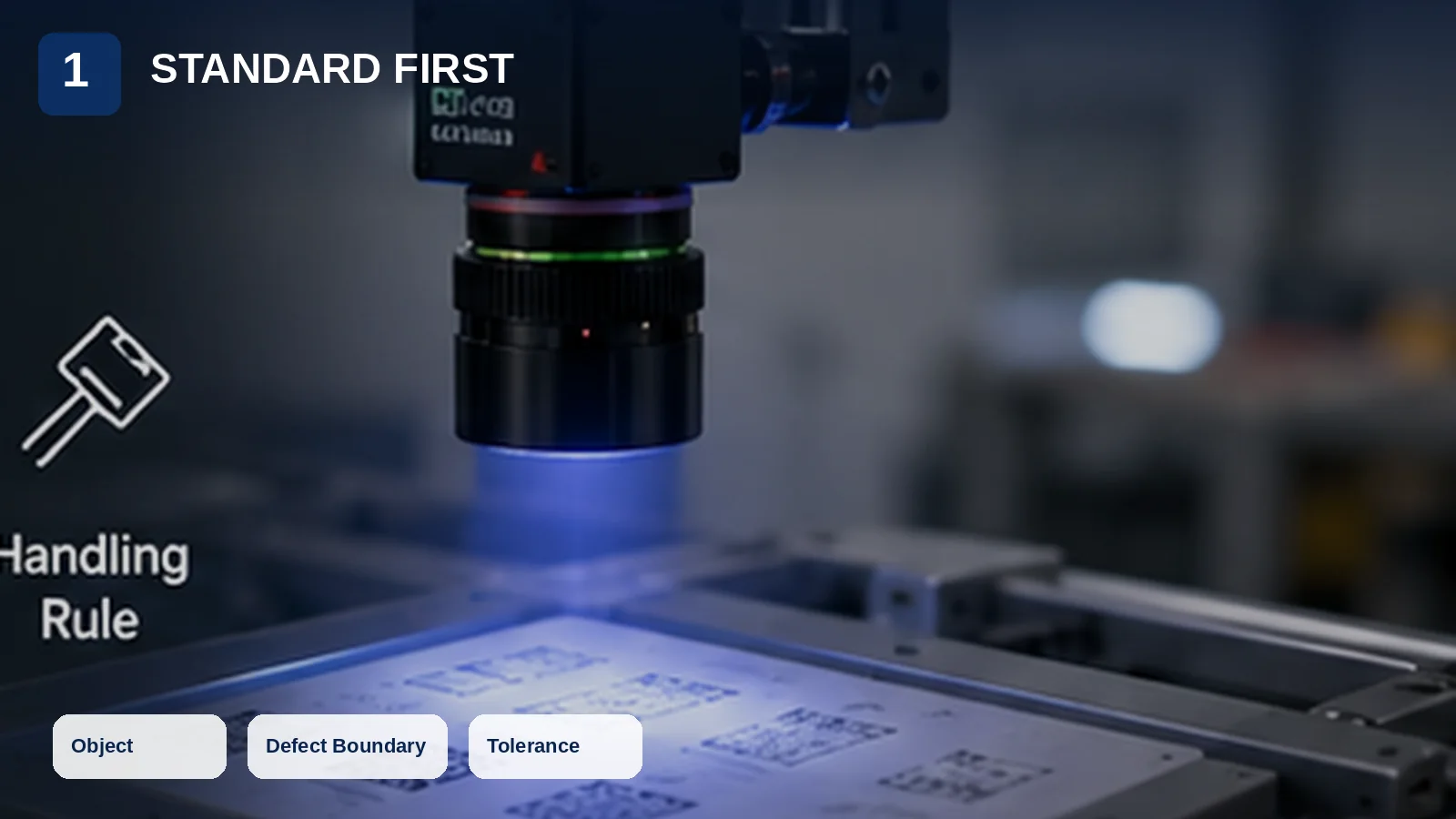
A vision system needs clear definitions for the inspection object, defect boundary and result handling. The object may be a printed character, QR code, label position, packaging defect, missing assembly feature or surface contamination. The boundary may be offset tolerance, stain area, broken line level, readability grade or blocked region.
If these rules are not agreed before commissioning, every parameter change becomes a negotiation between production, quality and equipment teams. The algorithm may become better, but the project still cannot tell the difference between an acceptable edge case and a real defect.
The sample library must include borderline samples
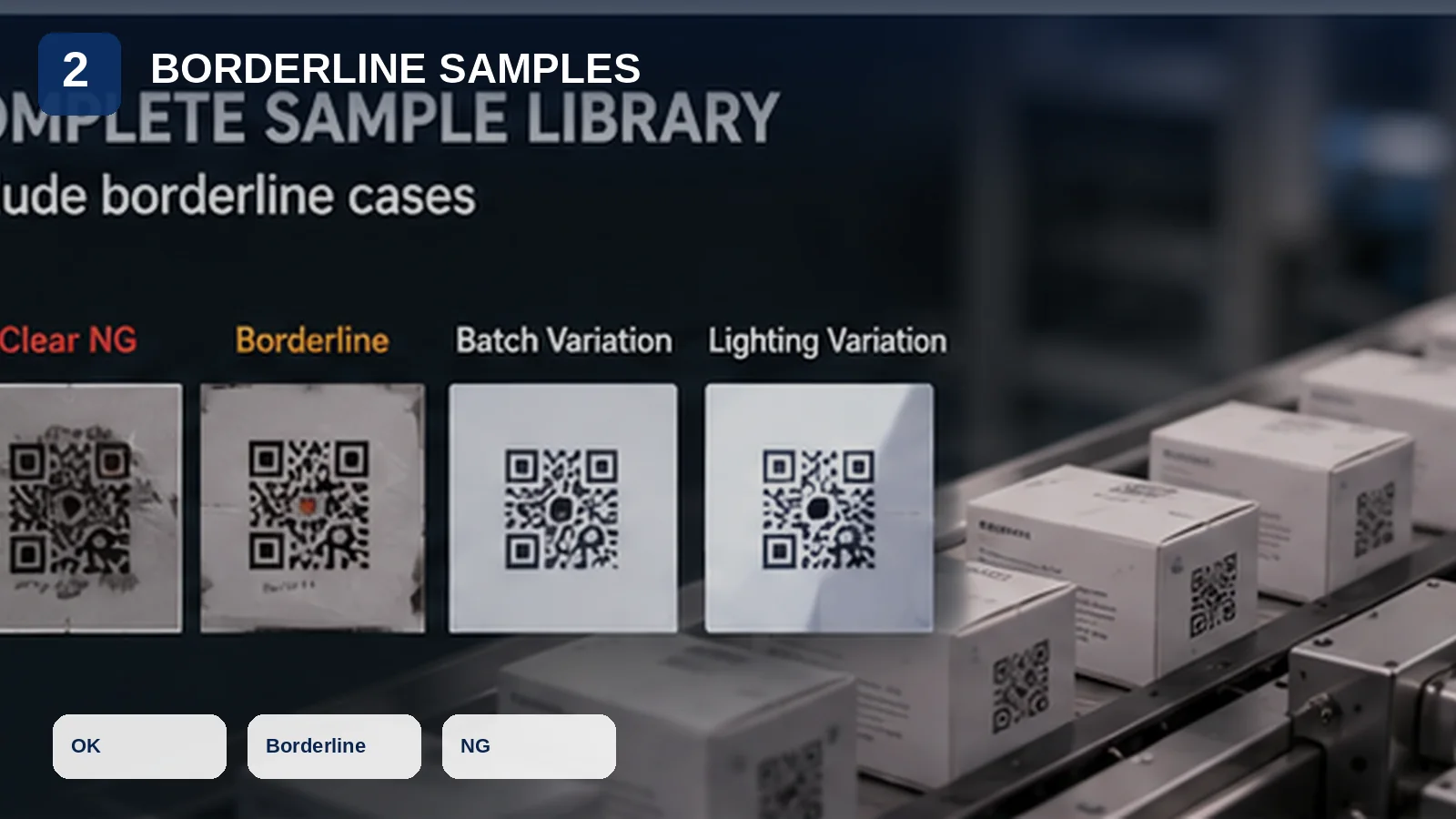
A reliable project cannot be validated only with perfect OK samples and obvious NG samples. Borderline samples are the most valuable because they reveal where false rejection and missed detection are likely to happen.
The sample set should include standard OK samples, clear NG samples, borderline samples, different material batches, reflective or low-contrast samples, lighting variation and typical on-site abnormal samples. This makes the inspection logic closer to real production conditions.
Offline validation and online commissioning are different tasks
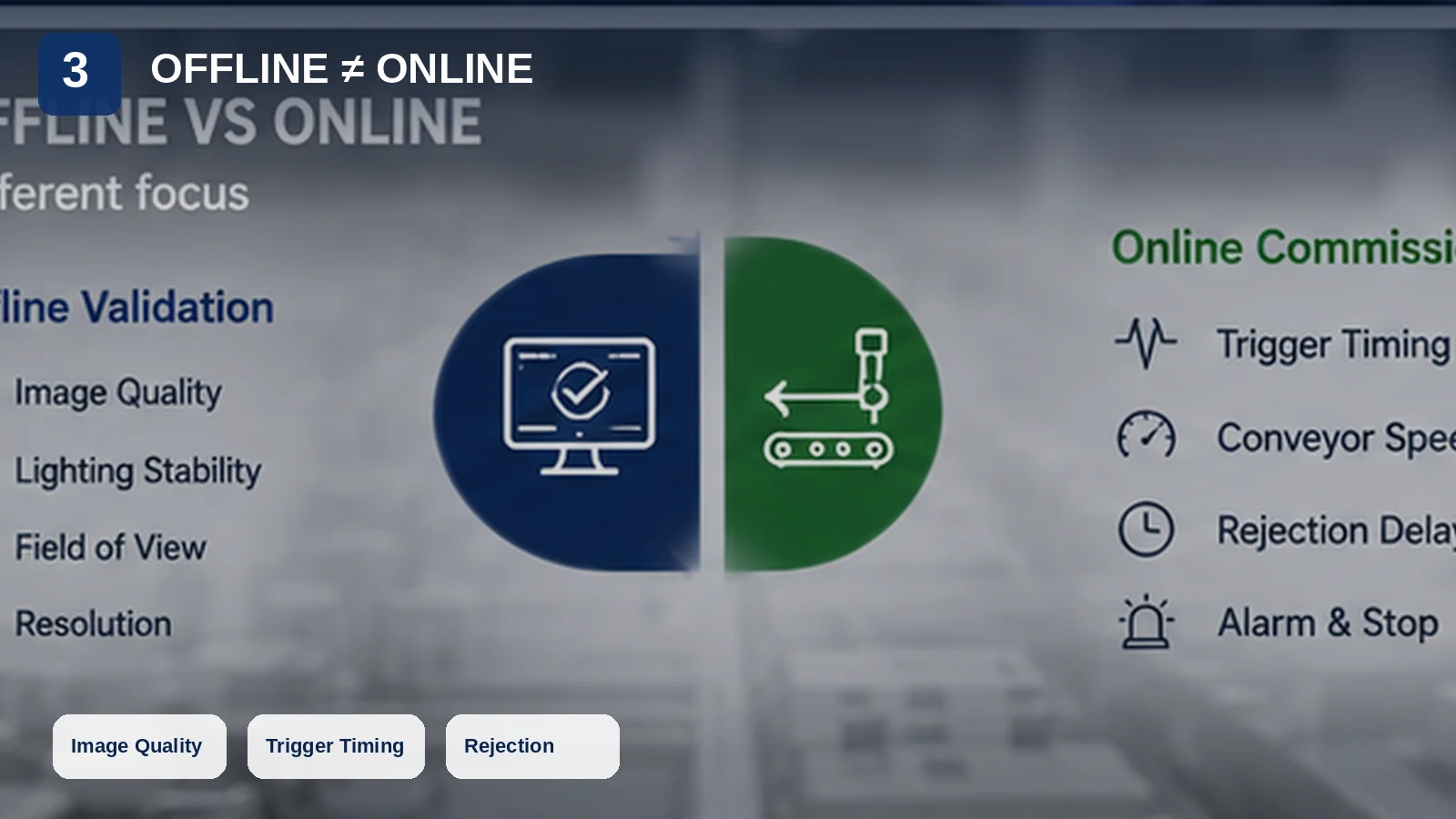
Offline validation should focus on imaging quality, lighting stability, field of view, reflection control, depth of field, resolution and material variation. Online commissioning should focus on PLC trigger timing, encoder signals, conveyor speed, product spacing, rejection delay, alarm logic and stop strategy.
Mixing these two phases makes problem diagnosis difficult. A blurred image, a delayed trigger and an incorrect rejection action are different failures, even if they appear as the same final NG result.
Inspection should close the loop with production data
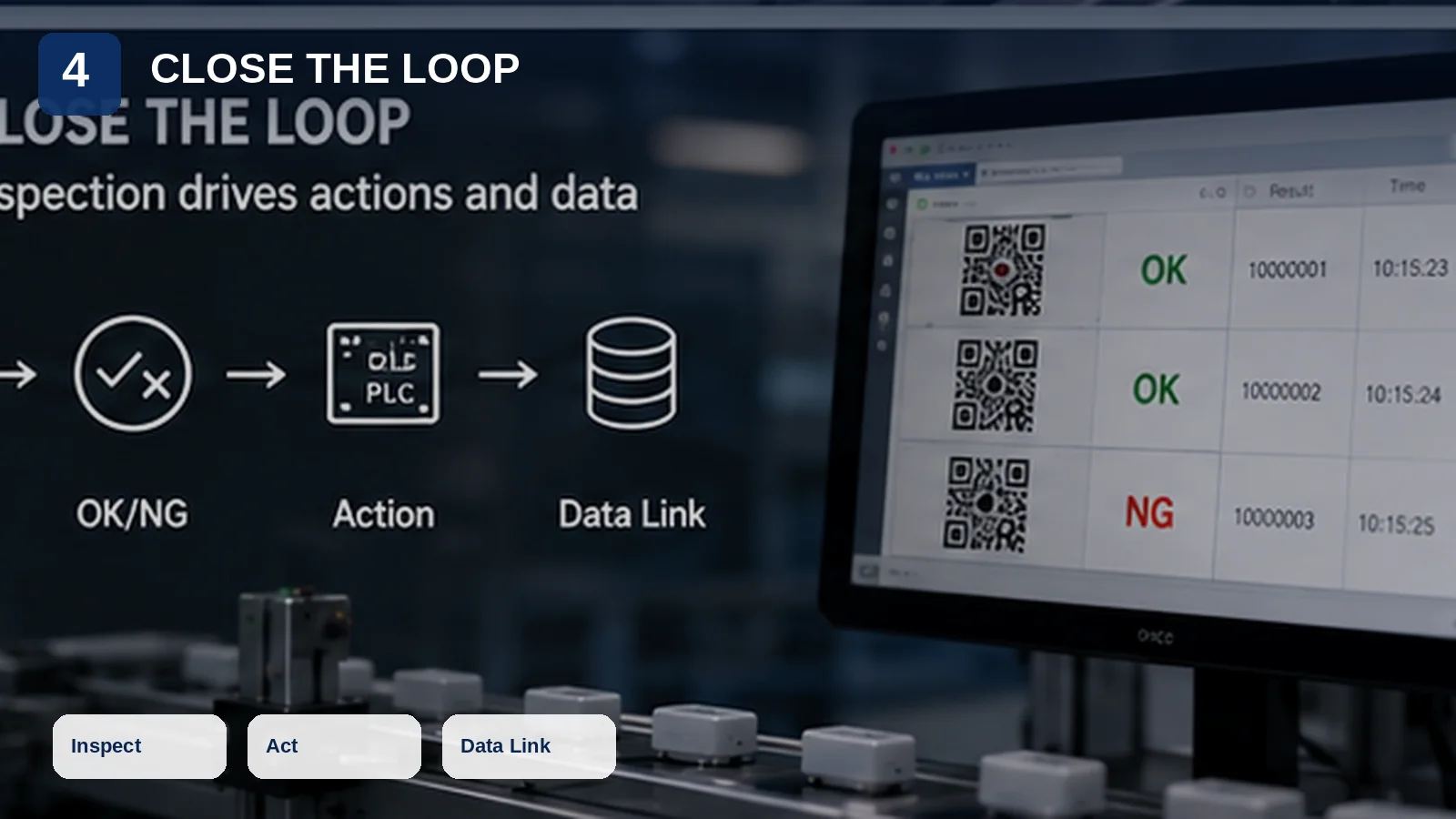
A vision inspection system should not only output OK or NG. For traceability, it should bind the result to product ID, batch, time, station and handling action. When the system detects a defect, the response may be alarm, reject, stop, recheck or data upload.
The value of inspection increases when it becomes a quality node in the production line rather than an isolated camera station.
Practical takeaway
The practical starting point for a vision inspection project is not to ask which algorithm is strongest. It is to ask who defines the standard, how borderline samples are handled, how trigger and rejection timing are verified, and how results are returned to the production data chain.
Need to evaluate a real production scenario?
Lugsicher can help review materials, marking targets, line speed, vision inspection and data feedback requirements before equipment selection.