
Wrong codes in production: product holds and a controlled restart
Wrong codes in production: product holds and a controlled restart
An incorrect batch marking, an outdated template or a duplicate serial number requires more than a machine reset. Even after stopping, products may remain in buffers, cartons or rework areas. This guide organises the next checks: identify affected goods, preserve data states and prepare a justified restart.
Define the affected scope using reliable checks
First preserve the fault evidence, job state and available event logs. An alarm timestamp alone does not reliably bound the affected quantity: transport and processing delays separate marking, inspection and notification. The clocks of the systems involved may also differ.
Working from the last demonstrably correct checkpoint, establish which products have been processed since then. Include the marking station, transport buffers, reject bins, manual removal, cartoning and, where relevant, goods already handed over. Where evidence is missing, the association initially remains unresolved. The responsible quality function determines the required scope of the hold; it must not be based solely on an assumption about the alarm time.
Record held goods clearly and keep them separate
A hold register should connect the job, batch, product variant, quantity range, location and processing status. Also describe which areas have already been checked and where further goods are expected. Prevent unresolved products from returning to the accepted-product flow when a buffer is emptied or the next job begins.
If automatic item tracking is unavailable, controlled manual identification and location records are required. Unreadable or unidentifiable products remain on hold until the specified decision has been made. A product’s identity cannot reliably be inferred from the code on its neighbour.
Preserve code status and packaging relationships before making changes
Downloading the correct job again does not correct earlier data states. For example, distinguish allocated, marked, inspected and investigation-held codes according to the system’s existing state model. Do not reset all affected serial numbers to available.
Rework requires an approved rule for retaining, replacing or discarding the identity. Existing relationships between individual product, carton and pallet must be carried through the process. Otherwise, a change to an individual product can leave an incorrect packaging association behind. Preserve original events and explain subsequent corrections; specific retention and release requirements depend on the product and the site’s quality system.
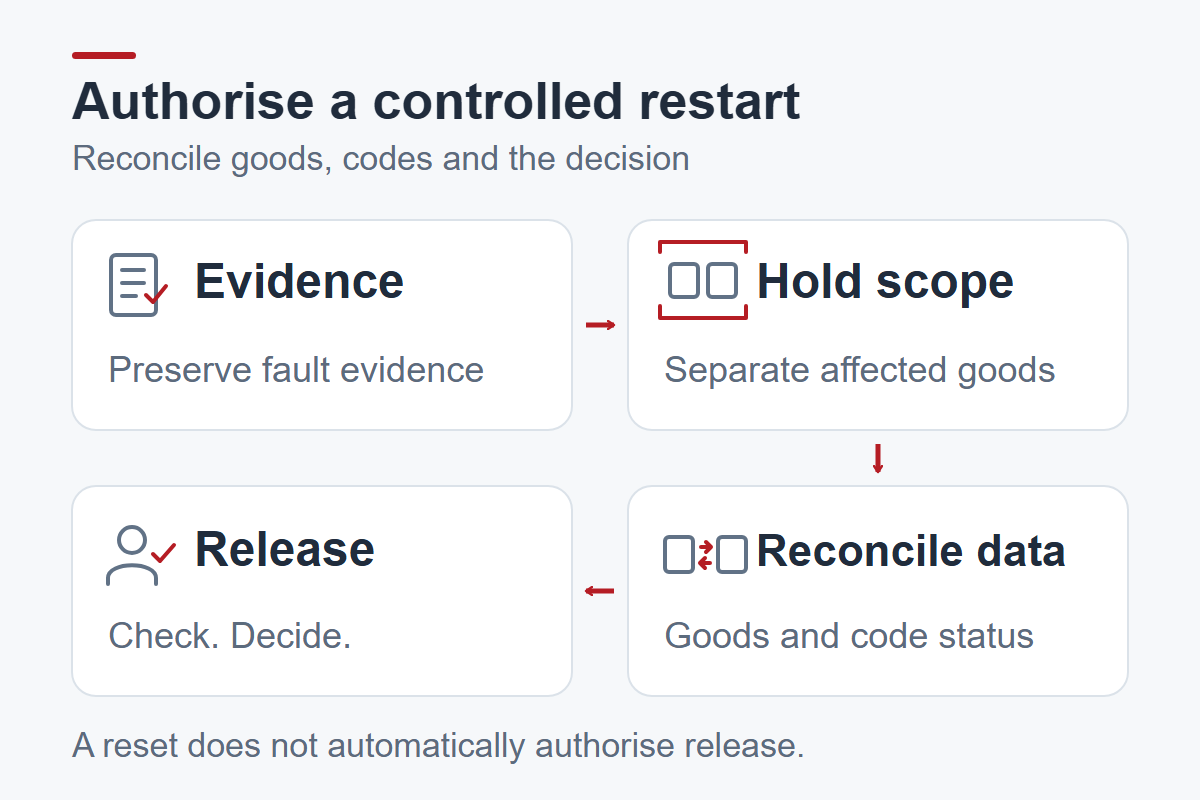
Reconcile the physical product with its data record
A clearly readable code may belong to the wrong job. Reconcile the decoded content, required data, job version, inspection result and actual product route. A display showing rejected is not complete evidence without corresponding feedback and a traceable record of where the product went.
A quantity reconciliation can expose unresolved differences: how many products were fed in, released, held, reworked or discarded? Not every line provides the same depth of data. Identify unresolved quantities and associations explicitly rather than concealing gaps with a general system acknowledgement.
Plan the restart as a connected functional test
Before authorising restart, establish the cause, such as an incomplete job change, retained template data or shifted trigger association. Repeated resets without investigating the cause do not confirm a stable correction. The restart test should connect the following points:
- The job, material, template and variable content agree.
- Marking and position meet the agreed requirements.
- Good products and controlled fault samples are evaluated correctly.
- The inspection result and reject action concern the same product.
- Product, carton and, where applicable, pallet relationships remain traceable.
After a suitable start-up check, also test at the intended production rate. Test scope, the number of initial items and release authority are defined in the applicable procedure, rather than by a universal item count.
Document decisions and remaining limitations
Record who initiated the hold, assessed its scope, approved rework, corrected data and authorised restart. The record should include the cause, affected goods, template or parameter changes, test evidence and the rationale for release.
This sequence describes general technical and organisational checks. It assumes no particular automatic functions and replaces neither product-specific requirements nor the site’s quality procedures. A reliable resumption of the process is possible only when product status, code state and the release decision agree.
GS1 describes the relationship between identification, product flow and data capture in its introduction to traceability. For systems using EPCIS, section 5.9 of the implementation guideline explains correction of erroneous events. Those specific EPCIS rules do not automatically apply to every MES.
Review your application with Lugsicher
Describe the material, code content, line cycle and the issue you have observed. This helps define the next checks for your application.
Discuss your project